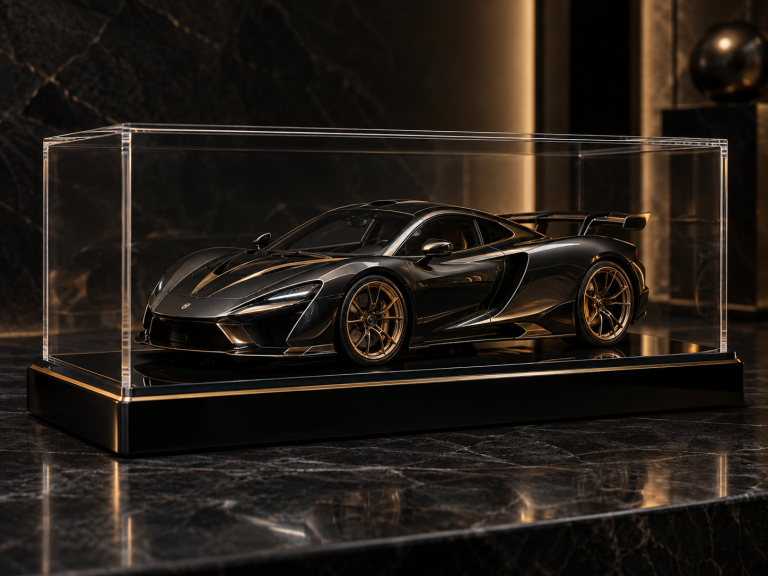
1:43 is one of the classic model car scales. It gives collectors noticeably more detail and presence than 1:64, while taking up far less space than larger 1:24 or 1:18 models. But how big is a 1:43 model car in real terms, and how much room should you allow when choosing a shelf or display case?
For a typical passenger car, a 1:43 model is usually around 9 to 12 centimetres long, roughly 4 to 5 centimetres wide and approximately 3 to 4 centimetres high. Those figures are only a guide because the finished model depends on the dimensions of the full-size vehicle. Long-wheelbase cars, SUVs, vans, racing transporters and commercial vehicles can be noticeably larger.
This guide explains what 1:43 scale means, how to estimate model dimensions, how it compares with other popular scales, and how much clearance to allow when choosing a model car display case.
What does 1:43 scale mean?
A 1:43 scale model is forty-three times smaller than the real vehicle it represents. In simple terms, every 43 units on the real car become one unit on the model.
For example, if a real car is 4,300mm long, dividing that figure by 43 gives a model length of approximately 100mm, or 10cm. A 4,730mm executive saloon would scale to about 110mm, while a 3,870mm compact car would be roughly 90mm long.
This is why there is no single fixed size for every 1:43 model. The scale is consistent, but the original vehicles are not.
Typical 1:43 model car dimensions
The table below gives a practical idea of the sizes collectors are likely to encounter.
| Full-size vehicle | Approx. 1:43 length | Typical example |
|---|---|---|
| 3.6m | 84mm / 8.4cm | Small city car |
| 4.0m | 93mm / 9.3cm | Compact hatchback |
| 4.3m | 100mm / 10cm | Medium family car |
| 4.6m | 107mm / 10.7cm | Sports car or saloon |
| 5.0m | 116mm / 11.6cm | Large saloon or SUV |
| 5.5m | 128mm / 12.8cm | Long vehicle or large SUV |
Most normal passenger cars therefore fall somewhere around the 9–12cm mark. Width is commonly around 4–5cm, while height is often around 3–4cm. Taller vehicles such as SUVs and vans can exceed those figures.
How to calculate the size of a 1:43 model
If you know the dimensions of the real vehicle, the calculation is straightforward:
Full-size dimension ÷ 43 = approximate model dimension.
Suppose a real vehicle measures 4,500mm long, 1,850mm wide and 1,450mm high:
- 4,500 ÷ 43 = approximately 105mm long
- 1,850 ÷ 43 = approximately 43mm wide
- 1,450 ÷ 43 = approximately 34mm high
That would produce a model roughly 10.5cm × 4.3cm × 3.4cm before allowing for mirrors, aerials, wings, open doors or any display plinth supplied with the model.
How much display space does a 1:43 model car need?
The model itself is only part of the equation. A good display should provide some breathing room around the car rather than fitting it tightly between the walls of a case.
For a typical 1:43 passenger car, it is sensible to allow at least a little extra clearance at the front, rear and sides. As a practical starting point, a single-car case with an internal length somewhere around 130–150mm will comfortably suit many standard 1:43 cars, but you should always measure the actual model first.
Depth and height matter too. A model that is only 42mm wide can still benefit from a case 70–90mm deep, giving the car visual space and making it easier to position. Around 60–80mm of internal height will suit many cars while leaving enough room above the roofline.
Those are display-planning figures rather than universal specifications. Large SUVs, vans, estate cars, racing cars with oversized wings and models mounted on their own bases may require more room.
Measure the actual model, not just the scale
Scale tells you the relationship between the model and the real vehicle, but it does not guarantee a particular finished footprint. Before buying a case, measure the longest, widest and highest points of the exact model you want to display.
Remember to include:
- door mirrors
- front and rear wings
- roof aerials
- spoilers
- display plinths
- openable panels if you want to display them open
Once you have those measurements, add enough clearance so the model does not look cramped. This also reduces the chance of touching delicate mirrors or trim when placing the car into the case.
1:43 vs 1:64: how much bigger is it?
A 1:43 model is substantially larger than a 1:64 version of the same car. A 4.3m vehicle would be around 10cm long at 1:43 but only about 6.7cm at 1:64.
That extra size makes body lines, wheels, interiors, liveries and trim easier to appreciate, while still keeping the footprint compact enough for larger collections. If shelf capacity is the priority, 1:64 remains extremely efficient; if you want more visual presence without moving into large-scale models, 1:43 is a very attractive middle ground.
For a broader comparison, see our 1:64 vs 1:43 vs 1:24 vs 1:18 model car scale guide or our dedicated guide to 1:64 model car dimensions.
1:43 vs 1:18: which takes up more room?
The difference is dramatic. A 4.3m car at 1:18 scale is approximately 24cm long, compared with around 10cm at 1:43. One 1:18 display can therefore occupy the shelf length of two or more 1:43 models, and its required depth is significantly greater too.
1:18 is excellent for statement pieces and fine detail, whereas 1:43 makes it easier to build a broad collection around marques, motorsport eras, road cars or vehicles you have owned without needing an entire room of shelving.
If you collect both, our guide to 1:18 model car dimensions and display space gives a useful comparison.
Why 1:43 is popular with collectors
A good balance of size and detail
At roughly 10cm long for many passenger cars, 1:43 is large enough for paint, wheels, liveries and bodywork to have real visual impact but small enough to display several models together.
Efficient use of shelf space
A row of 1:43 cars can create a substantial collection without requiring deep furniture or oversized cabinets. This is particularly useful in home offices, studies and collector rooms where wall space may be easier to find than floor space.
Ideal for themed collections
The scale works especially well when the appeal comes from the collection as a whole: a manufacturer timeline, rally cars, touring cars, Formula 1 support vehicles, classic road cars or every car a collector has personally owned.
Single-car or multi-car display?
There is no single best answer. A single case makes one important model feel more like a centrepiece, while multi-car and wall mounted displays are often more efficient for collectors with dozens of models.
For a special limited-edition model, a bespoke single-car enclosure with a clean black base can give the car greater visual importance. For a growing collection, a multi-level case can provide better density and consistency.
Our 1:43 model car display cases are the most relevant place to start when comparing display options for this scale.
Should 1:43 models be displayed in a case?
You can display 1:43 models on an open shelf, but an enclosed case reduces how much dust reaches the model and creates a physical barrier against accidental contact. That is particularly useful for delicate mirrors, aerials, decals and small trim pieces.
An enclosure can also make a collection look more deliberate. Instead of individual cars simply sitting on furniture, the case visually frames them as a collection.
If you are deciding between materials, read our guide to acrylic vs glass display cases for model cars. For ongoing care, our article on protecting model cars from dust, damage and handling covers cleaning and storage in more detail.
How many 1:43 cars can fit in a display?
That depends on the usable internal width and the spacing you prefer. As a simple example, a shelf with around 430mm of usable width can usually accommodate three or four typical 1:43 passenger cars when arranged side by side with comfortable spacing. Angling the cars slightly will reduce capacity but can create a more dynamic display.
For larger collections, vertical shelf spacing becomes equally important. Around 55–70mm between shelves is often practical for ordinary passenger cars, but taller vans, SUVs and models on plinths need more.
Capacity should never be calculated only from the nominal scale. Measure a representative group of the largest models in your collection before committing to a case.
What size case should I choose for a 1:43 model car?
For one standard passenger car, start with the exact model dimensions and add clearance on every side. If the model measures 105mm × 43mm × 34mm, for example, a case with an internal footprint around 130–150mm long and 70–90mm deep will usually give it a much more considered presentation than a tight-fitting enclosure.
If you plan to display several cars, decide whether you want maximum capacity or more generous spacing. A dense collection can look impressive when organised consistently, while extra room around each model creates a more gallery-like appearance.
The key point is simple: choose the case around the actual models rather than relying on “1:43” alone.
How should 1:43 cars be arranged?
Consistent spacing usually makes the biggest difference. Keep similar gaps between cars and try to organise the collection by a clear theme such as manufacturer, colour, era, motorsport series or vehicle type.
For wall displays, rows of cars facing the same direction create a clean, architectural appearance. Alternating directions or slightly angling selected models can work well when you want a more informal showroom feel.
Dark bases and back panels tend to increase contrast around bright paint finishes, while clear enclosures keep the visual focus on the models themselves.
Frequently asked questions
How long is a 1:43 model car?
Most ordinary passenger cars are around 9–12cm long at 1:43 scale. Compact cars may be shorter, while large SUVs, estates and long-wheelbase vehicles can be longer.
How wide is a 1:43 model car?
A typical modern passenger car is often around 4–5cm wide at 1:43 scale, excluding unusual bodywork or oversized mirrors.
How tall is a 1:43 model car?
Many cars are around 3–4cm high. Sports cars may be lower, while SUVs, vans and commercial vehicles can be considerably taller.
Is 1:43 bigger than 1:64?
Yes. A 1:43 model is larger than a 1:64 model of the same vehicle because the denominator is smaller. A car around 10cm long at 1:43 might be only 6–7cm long at 1:64.
Is 1:43 smaller than 1:18?
Yes. A 1:18 model is more than twice the length of the same vehicle at 1:43, and the difference in overall volume is even greater.
What display case is best for a 1:43 model?
The best case is one with enough internal clearance for the exact model and the style of presentation you want. Clear acrylic is a popular choice because it provides high visibility with relatively low weight, while enclosed displays help reduce dust and accidental handling.
Final thoughts
For most passenger cars, thinking of 1:43 as roughly a 10cm-long model scale is a useful starting point. It is compact enough for substantial collections but large enough for individual cars to retain real visual presence.
When planning a display, do not buy purely from the scale label. Measure the actual model, include mirrors and accessories, then add enough clearance to make the car easy to position and enjoyable to view.
Explore our 1:43 model car display cases, or visit the Model Car Display Cases hub for more ways to protect and present your collection.