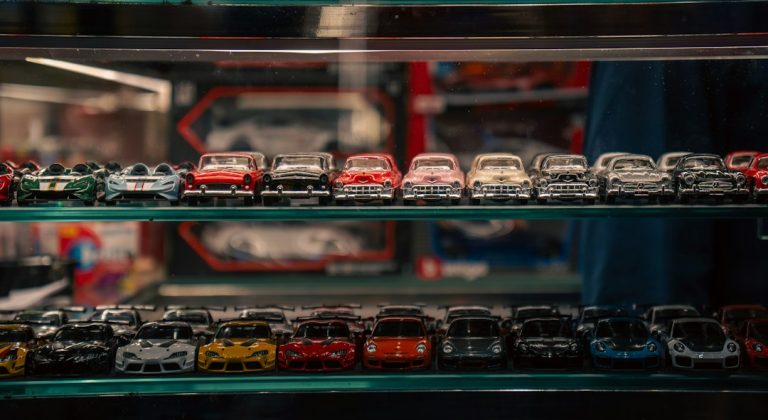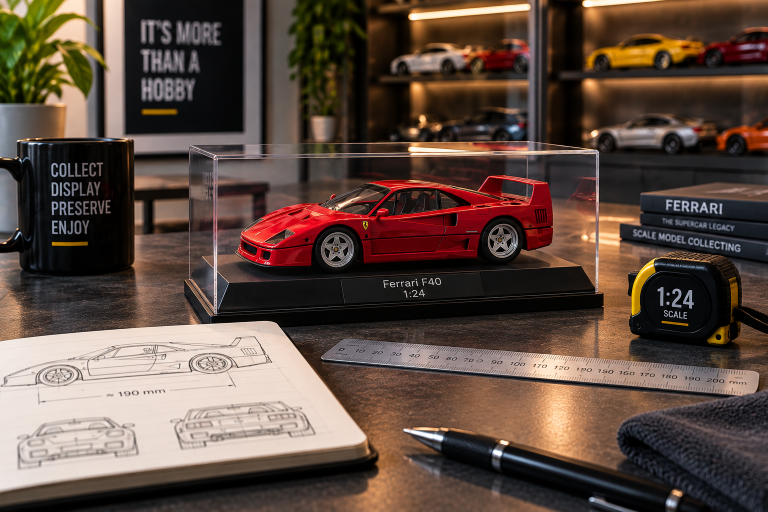
A model car can spend years looking exactly as it did when it left the box — or it can gradually collect dust, fingerprints, scratches and small pieces of damage that become difficult to reverse. The difference usually comes down to how the model is displayed, handled and cleaned.
This guide explains how to protect model cars from dust, damage and handling without turning your collection into something you are afraid to enjoy. The aim is simple: reduce unnecessary contact, keep the environment stable and make routine cleaning as gentle as possible.
Quick answer
What is the best way to protect a model car?
For most collectors, the strongest everyday protection comes from an enclosed display case, a stable indoor location away from direct heat and strong sunlight, careful handling from solid areas of the model, and light regular cleaning with soft tools. The less frequently a model needs to be picked up and dusted, the lower the chance of accidental scratches or broken details.
The main risks to a model car collection
Model cars are display pieces, but many of their smallest details are also their most vulnerable. Mirrors, aerials, spoilers, photo-etched parts, windscreen wipers and opening panels can all be damaged by surprisingly little force.
The most common risks are:
- Dust: settles into panel gaps, interiors, grilles and textured surfaces.
- Fingerprints and skin oils: can leave visible marks on paint, glazing and polished surfaces.
- Scratches: often caused by dry wiping, rough cloths or contact with other models.
- Accidental knocks: from shelves, cleaning, children, pets or moving furniture.
- Heat and strong sunlight: can place unnecessary stress on plastics, adhesives, paints and packaging over time.
- Damp or unsuitable storage: can encourage corrosion, staining or deterioration of packaging and metal components.
- Over-handling: repeatedly opening doors, bonnets and moving parts increases wear and the chance of breakage.
| Risk | Simple protection | Why it helps |
|---|---|---|
| Dust | Enclosed case or cabinet | Reduces how often the model needs direct cleaning |
| Fingerprints | Clean, dry hands and minimal handling | Limits oils and marks on paint and glazing |
| Scratches | Soft brush, blower and clean microfibre | Avoids dragging abrasive particles across surfaces |
| Knocks | Stable shelf or secured display | Reduces accidental contact and falls |
| Heat / sunlight | Indoor position away from windows and radiators | Helps keep the display environment more stable |
| Moisture | Dry, ventilated room | Reduces the risk of corrosion and damp-related damage |
How to protect model cars from dust
Dust is the most routine problem because it never really stops arriving. An open model on a shelf can need frequent cleaning, and every cleaning session creates another opportunity to catch a mirror, mark the paint or push dust into a panel gap.
That is why prevention is usually better than constant cleaning.
Use an enclosed display case
A clear acrylic or glass enclosure dramatically reduces the amount of airborne dust landing directly on the model. It will not make the display completely maintenance-free — the outside of the case still needs cleaning and a small amount of dust can enter when it is opened — but it reduces direct contact with the model.
If you are deciding between materials, our Acrylic vs Glass Display Cases guide compares clarity, weight, scratch resistance and maintenance.
Do not crowd models together
Tightly packed rows are harder to clean. You may have to move several cars simply to reach one dusty area, which increases handling. Leaving a little space around each model makes cleaning easier and gives the collection a more considered appearance.
Keep the surrounding room clean
Display cases help, but dust levels in the room still matter. Regularly cleaning nearby shelves, skirting boards, vents and surfaces reduces the amount of dust that can settle on the case or enter when it is opened.
How to clean dust from a model car safely
If a model is already dusty, avoid immediately rubbing it with a cloth. Dust can contain fine abrasive particles, and pressing them against a glossy painted surface may create tiny marks.
A safer sequence is:
- Place the model on a clean, soft, stable surface.
- Use a hand-operated air blower or very gentle air movement to lift loose dust.
- Use a very soft detailing or make-up-style brush to loosen dust from grilles, wheels and panel lines.
- Only use a clean microfibre cloth where necessary on broad, robust surfaces.
- Use minimal pressure and avoid fragile trim, decals, aerials and mirrors.
Cleaning tip
Remove particles before wiping
The safest cloth is still capable of scratching if grit is trapped underneath it. Blow or brush away loose particles before wiping glossy surfaces.
Should you use compressed air on model cars?
Compressed air can be useful, but it needs care. A strong blast can move lightweight parts, force dirt into gaps or damage loose details. Canned air can also discharge propellant or become very cold if used incorrectly.
For routine dusting, a manual camera-style air blower is often easier to control. If you use compressed air, keep the pressure low, keep the nozzle well away from the model and never aim directly at delicate mirrors, decals, aerials or loose accessories.
How to handle model cars without damaging them
Many small accidents happen while a model is being moved rather than while it is sitting on display. The safest approach is to treat decorative details as visually important but structurally fragile.
Start with clean, dry hands
Wash and thoroughly dry your hands before handling a valuable model. This reduces grease, food residue and dirt being transferred onto the paint or glazing.
Gloves are not automatically safer. Loose cotton gloves can reduce grip and may catch on small details. If you do use gloves, they should fit well and allow you to hold the model securely.
Lift from strong areas
Where possible, support the model from underneath the chassis, base or another solid structural area. Avoid lifting by:
- mirrors
- roof racks
- spoilers or wings
- doors or bonnets
- windscreen frames
- exhausts
- aerials
- photo-etched trim
Use two hands for larger scales
Large 1:18 and 1:24 models can be heavier than they look. Supporting both ends reduces the chance of dropping the car or putting too much pressure on one wheel or body section.
If you collect multiple scales, our Model Car Scale Comparison Guide explains how size changes the amount of display space each model needs.
How to prevent scratches on model cars
Gloss paint, clear plastic glazing and polished bases can show fine marks easily. Most scratch prevention comes from avoiding unnecessary contact.
- Never slide a model across a hard shelf.
- Do not stack loose models against one another.
- Keep jewellery, watches and metal zips away from the model while handling it.
- Use a soft mat or clean towel as a temporary work surface.
- Keep cleaning cloths dedicated to display items rather than general household cleaning.
- Do not use abrasive polish unless you fully understand the model’s finish.
Painted diecast, clear plastic, chrome-effect finishes, tampo printing and waterslide decals can all react differently to cleaning products. If the manufacturer provides care instructions, follow those first.
How to protect clear plastic windows and acrylic parts
Clear model glazing and acrylic display cases require a gentler approach than household glass. Strong cleaners and rough cloths can leave haze or fine scratches.
For an acrylic case, use a clean soft microfibre cloth and a cleaner specifically suitable for acrylic where needed. Avoid assuming ordinary glass cleaner is appropriate, particularly products containing ammonia or aggressive solvents.
When cleaning the case, remove the cover carefully and place it on a clean soft surface. Do not drag it across a desk or shelf, because small particles underneath can mark the acrylic.
Should model cars be kept out of direct sunlight?
It is sensible to keep collections away from prolonged direct sunlight. Strong sunlight can heat the inside of a display area and may contribute to fading or ageing of paints, plastics, decals and packaging over long periods.
Position valuable displays away from windows where possible, or use curtains and blinds during periods of strong direct sun.
Importantly, do not assume a display case provides UV protection unless the material specification explicitly states that it does. A clear enclosure can protect from dust and handling without necessarily providing meaningful UV filtering.
Keep model cars away from excessive heat
A stable indoor environment is preferable to placing models beside radiators, heaters, fireplaces or equipment that produces substantial heat. High temperatures can affect plastics, tyres, adhesives and packaging, while repeated hot-and-cold cycles can be harder on materials than a relatively stable room.
Lofts, sheds and garages can also experience larger temperature changes than occupied rooms, so consider the environment carefully before using them for long-term storage.
How moisture can damage a collection
Diecast models contain metal components, while packaging commonly includes card and paper. Damp storage therefore creates avoidable risks.
Signs that the environment may be unsuitable include condensation, a persistent musty smell, visible mould on nearby items or corrosion on exposed metal.
For most collections, a normal dry, ventilated indoor room is preferable to a damp garage, cellar or shed. Avoid sealing a model away while it is wet or immediately after using any water-based cleaner.
Protecting models from children, pets and accidental knocks
A model does not need to be mishandled deliberately to become damaged. A wagging tail, curious child, vacuum-cleaner cable or sleeve brushing a shelf can be enough.
For valuable or fragile models:
- use a stable display surface that cannot easily be bumped;
- keep models away from shelf edges;
- consider wall mounted or enclosed displays where appropriate;
- make sure wall displays are installed according to their fixing instructions;
- avoid placing expensive models on unstable freestanding furniture.
If floor and shelf space is limited, see our Wall Mounted Car Displays guide and collection.
Are display cases worth it for protecting model cars?
For collectors who want to reduce dust and handling, an enclosed case is one of the simplest upgrades. Instead of cleaning the model itself every time dust appears, you mainly clean the outer enclosure.
A case can also create a physical barrier against casual touching and small accidental knocks while making the model feel more like a deliberately presented object.
That does not mean every inexpensive model needs its own individual enclosure. Multi-car cases, cabinets and wall displays can make more sense for larger collections. The right solution depends on scale, value, available space and how often you rearrange the collection.
Explore Model Car Display Cases →
How often should you clean model cars?
There is no fixed schedule. Clean when the model actually needs it rather than handling it simply because a calendar says it is time.
An enclosed model may need very little direct cleaning, while an open-shelf model in a busy room may collect visible dust quickly. Gentle, infrequent cleaning is usually preferable to constant polishing.
The case or shelf can be cleaned more regularly than the model itself. This keeps the surrounding area tidy without repeatedly touching delicate parts.
Protecting models during rearranging or moving house
Moving a collection creates a different set of risks. Do not place loose models together in a box where they can collide.
Where available, original packaging and shaped internal supports are often useful because they were designed around the model’s shape. Otherwise:
- wrap or protect each model individually without putting pressure on mirrors or spoilers;
- use a rigid outer box;
- stop the model moving inside the box;
- keep heavy items away from delicate models;
- label the box clearly;
- carry valuable models yourself where practical.
Take photographs before packing high-value pieces. This gives you a record of condition and can also help you remember how small detachable components were positioned.
Should you keep the original box?
If you have the storage space, keeping original packaging can be useful. It provides a fitted storage option for moving the model and may matter to collectors if the model is ever sold later.
Store boxes somewhere dry and clean. There is little benefit in preserving the model perfectly while allowing the packaging to become damp, crushed or sun-faded.
A simple model-car protection routine
You do not need an elaborate conservation routine for an everyday collection. A few consistent habits achieve most of the benefit:
- Display models in a stable indoor location.
- Use enclosed cases for models you want to dust less frequently.
- Keep them away from direct heat and prolonged strong sunlight.
- Handle only when necessary and lift from strong structural areas.
- Remove loose dust before wiping.
- Use soft, clean tools and material-appropriate cleaners.
- Leave enough space around each model to avoid accidental contact.
- Inspect shelves, cases and wall fixings occasionally.
Frequently asked questions
What is the safest way to dust a model car?
Start with gentle air movement and a very soft brush to remove loose particles. Use a clean microfibre cloth only where necessary and avoid pressing dust into glossy surfaces.
Can I use household polish on a diecast model?
It is better not to use general household polish unless the model manufacturer specifically recommends it. Different paints, plastics, decals and plated finishes can react differently to chemicals and solvents.
Should I wear gloves when handling model cars?
Not necessarily. Clean, dry hands often give better grip. Loose gloves can snag fragile details. Well-fitting gloves can be useful in some situations, but secure handling is more important than gloves alone.
Do acrylic display cases stop dust?
They substantially reduce direct dust exposure compared with an open shelf, although no regularly opened display should be treated as perfectly sealed. The main benefit is reducing how often you need to clean the model itself.
Do display cases protect model cars from UV light?
Only if the specific material is documented as providing UV filtering or protection. Clear acrylic or glass should not automatically be assumed to block damaging UV simply because the model is enclosed.
Can I clean a model car with water?
Avoid soaking a model. Water can reach hinges, screws, decals, electronics or metal components. For local cleaning, use the least moisture necessary and follow the manufacturer’s care instructions where available.
Where is the safest place to display valuable model cars?
A stable indoor shelf, cabinet or properly installed wall display away from direct sunlight, excessive heat, damp and heavy foot traffic is a good starting point. An enclosure adds further protection from dust and casual contact.
Protect the collection without hiding it away
The best protection strategy is not to lock your models away where nobody can enjoy them. It is to remove the avoidable risks that cause most everyday damage.
Reduce dust with an enclosure, minimise direct handling, use gentle cleaning methods and choose a stable environment. Those simple steps can keep a collection looking much better while still allowing the cars to remain part of the room.
For more display advice, explore our Model Car Display Cases, read the Complete Guide to Model Car Display Cases, or compare case materials in Acrylic vs Glass Display Cases: Which Is Best for Model Cars?.