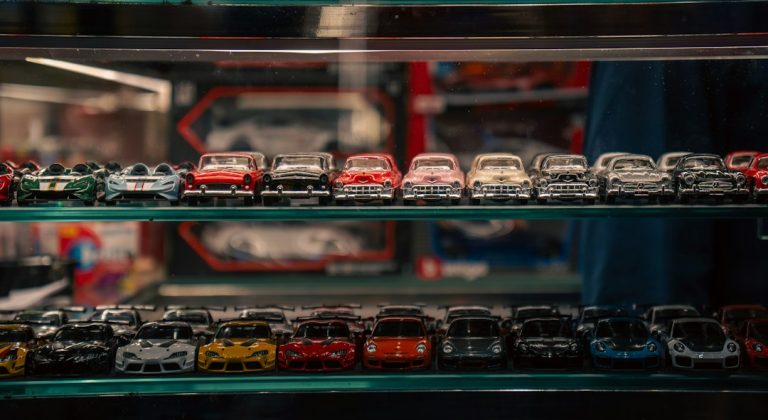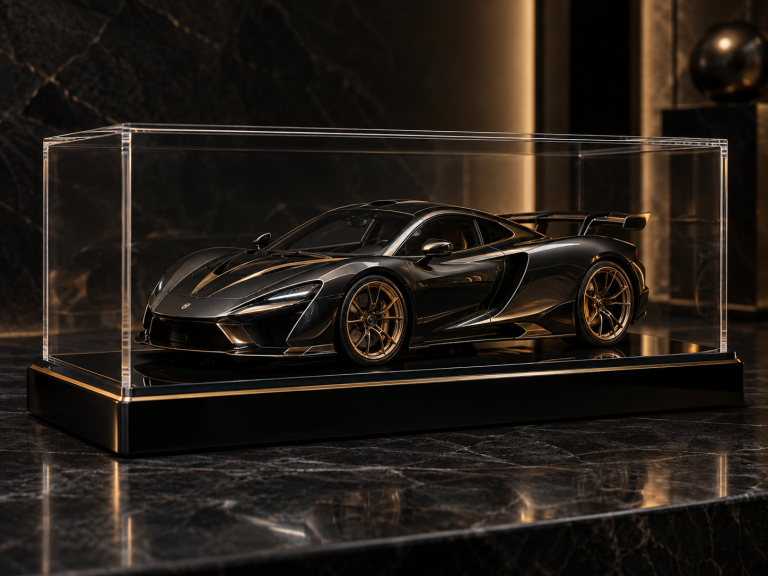
Model car scale is one of the first things collectors notice, but it can also be one of the easiest things to misunderstand. A 1:18 model is much larger than a 1:64 model, yet the number alone does not tell you how much shelf space you will need, how detailed the model may feel in person or how quickly a collection can grow.
In this guide, we compare four of the most popular model car scales — 1:64, 1:43, 1:24 and 1:18 — so you can see the practical differences before choosing what to collect or how to display it.
Model car scales at a glance
The easiest way to understand model scale is to think of it as a ratio. A 1:18 model represents a real vehicle reduced to one eighteenth of its full size. A 1:64 model represents the same idea at one sixty-fourth of full size.
Because real cars vary in length, width and height, there is no single exact dimension for every model at a particular scale. A 1:18 city car will be shorter than a 1:18 limousine, for example. The figures below are therefore useful typical ranges, not guaranteed dimensions.
| Scale | Typical model length | Space required | Typical collector appeal |
|---|---|---|---|
| 1:64 | Approx. 6–8 cm | Very low | Large collections, variety and compact displays |
| 1:43 | Approx. 9–12 cm | Low to moderate | Balanced collections with more visible detail |
| 1:24 | Approx. 17–20 cm | Moderate | Feature models and mid-sized displays |
| 1:18 | Approx. 23–30 cm | High | Statement pieces and highly detailed models |
Quick answer
Which model car scale should you choose?
If you want to collect many cars in a relatively small area, 1:64 is usually the easiest scale to live with. If you want a balance of size and detail, 1:43 is a strong middle ground. If you prefer larger models that feel more substantial on a shelf, look at 1:24. If individual cars are intended to become display pieces in their own right, 1:18 is often the most visually impressive.
What does 1:64 scale mean?
A 1:64 model is sixty-four times smaller than the real vehicle it represents. For a typical passenger car, that often means a model around 6 to 8 centimetres long, although longer vehicles can exceed that range.
For a more detailed breakdown of measurements, shelf space and case sizing, read our How Big Is a 1:64 Model Car? guide.
The biggest advantage of 1:64 is efficiency. A collector can display many vehicles in the space required by only a few larger models. That makes the scale particularly attractive for collectors who enjoy building themed groups, manufacturer collections, motorsport grids or large displays.
Why collectors choose 1:64
- It is easy to build a broad collection without needing a dedicated room.
- Multi-car displays work especially well because several models can be grouped together without feeling oversized.
- Storage and rearrangement are generally simpler than with larger scales.
- A wall mounted display can hold a substantial collection while using very little floor or shelf space.
The trade-off is physical presence. Even a beautifully detailed 1:64 model will not dominate a room in the way a large 1:18 model can. The pleasure often comes from the collection as a whole rather than one individual car.
What does 1:43 scale mean?
A 1:43 model is forty-three times smaller than the real car. Typical passenger-car models are often around 9 to 12 centimetres long. That extra size compared with 1:64 can make details such as body shapes, wheels, liveries and trim easier to appreciate without demanding dramatically more space.
For many collectors, 1:43 sits in an attractive middle ground. It is large enough to feel like a display model rather than a miniature toy, yet compact enough for dozens of cars to coexist on shelving or in multi-car cases.
Why collectors choose 1:43
- It offers a good balance between visual detail and practical storage.
- Collections can still become substantial without taking over an entire room.
- Individual models have more presence than 1:64 while remaining easy to group.
- It works well for collectors who want consistency across road cars, race cars or historic vehicles.
If 1:64 feels a little too small but 1:24 or 1:18 would use too much space, 1:43 is often the most practical compromise.
What does 1:24 scale mean?
A 1:24 model represents the real vehicle at one twenty-fourth of its full size. Typical car models are often around 17 to 20 centimetres long, although the exact measurement depends on the vehicle being reproduced.
At this size, models begin to feel much more substantial. They occupy noticeably more depth on a shelf and generally need greater spacing around them if the display is to feel deliberate rather than crowded.
Why collectors choose 1:24
- The car has enough size to become a clear feature on a desk, shelf or cabinet.
- Exterior details are easier to appreciate from normal viewing distances.
- The scale works well for smaller collections where each model has been chosen carefully.
- It can offer a strong compromise for collectors who like large models but do not have the room for multiple 1:18 cars.
The main consideration is space. Six 1:24 models can occupy a meaningful amount of shelving, so planning the display before the collection grows is worthwhile.
What does 1:18 scale mean?
A 1:18 model is eighteen times smaller than the full-size vehicle and is commonly around 23 to 30 centimetres long for a typical car. Larger vehicles can be longer still.
For exact sizing examples, display-space planning and case guidance, see our How Big Is a 1:18 Model Car? guide.
This is the scale where individual models often become statement pieces. Doors, bonnets or boots may open on some models, interiors can be easier to inspect and the overall proportions of the car are much more visually dominant in a room.
Why collectors choose 1:18
- Individual cars have strong visual presence.
- Fine exterior and interior details are easier to appreciate.
- A single important model can form the centrepiece of a display.
- The scale suits collectors who prefer fewer, carefully selected cars rather than very large quantities.
The disadvantage is simple: 1:18 cars need room. They require more shelf depth, more width and generally benefit from more empty space around them. A collection of twenty 1:18 cars needs a very different display plan from twenty 1:64 models.
1:64 vs 1:43 vs 1:24 vs 1:18: which takes up the most space?
The difference between scales becomes much clearer when you think about collections rather than single cars. One 1:18 model is manageable almost anywhere. Ten or twenty of them are a different proposition.
As a rough rule, the larger the model, the more important it becomes to plan not only the footprint of each car but also the space between models. Larger models usually look best when they have some breathing room, so simply placing them edge-to-edge can make an otherwise premium collection feel cramped.
Best for maximum capacity
1:64
Ideal when the goal is to display many cars efficiently or build large themed collections.
Best middle ground
1:43
Offers more visual presence while still allowing a relatively large collection in modest space.
Best mid-size feature
1:24
Works well when each model should feel substantial without requiring the footprint of 1:18.
Best for statement pieces
1:18
Needs the most room but gives each model far greater visual impact.
Which model car scale has the most detail?
Larger scale usually makes detail easier to see, but scale alone does not determine quality. A premium 1:64 model can be better finished than a basic 1:18 model. Manufacturer, price point, materials and production quality all matter.
What larger scales do provide is more physical room for details to be represented. At 1:18, components such as grilles, brake discs, dashboards, seats and engine-bay elements can be physically larger and therefore easier to reproduce and inspect. At 1:64, manufacturers have to represent the same features in a much smaller space.
So if your priority is studying one car closely, a larger scale usually has the advantage. If your priority is seeing an entire racing grid, manufacturer history or themed collection together, smaller scales can be more satisfying.
Which scale is best for a large collection?
For a genuinely large collection, 1:64 is normally the easiest scale to accommodate, with 1:43 also working very well. Both allow collectors to organise cars into rows, grids or wall displays without requiring enormous amounts of furniture.
That does not mean large 1:18 collections are impossible. They simply require more deliberate planning. Dedicated shelving, display cabinets or wall systems may become part of the hobby itself.
If you already know that your collection is likely to grow into the hundreds, it is sensible to think about the display system early. Consistent spacing and repeatable case sizes can prevent a collection becoming difficult to organise later.
Can you mix different model car scales in one collection?
Absolutely. There is no rule saying a collection has to use one scale. Many collectors buy the cars they like regardless of scale, particularly when a particular model is only available in one format.
The challenge is presentation. A 1:18 car beside a 1:64 car creates an enormous visual difference. If multiple scales are being displayed together, grouping them by scale usually produces a cleaner result than randomly alternating sizes.
Another option is to create separate display zones: for example, one wall for 1:64, a shelf for 1:43, and individual cases for important 1:18 models.
How does scale affect the display case you need?
The display should always be chosen around the actual model rather than the scale label alone. Two cars at the same scale can still have noticeably different dimensions because their full-size counterparts are different lengths and widths.
Before choosing a case, measure the model at its widest, longest and tallest points. Include mirrors, spoilers, aerials and any opening parts you intend to display in a particular position. Then allow some clear space around the car so the case feels intentional rather than tightly packed.
Display planning
Allow the model some breathing room
A case that technically fits is not always a case that looks good. Leaving visible space around the model helps the car remain the focal point and makes the overall display feel more premium.
Which model car scale is best for you?
There is no universally best model car scale. The right choice depends on what you enjoy most about collecting.
- Choose 1:64 if you want variety, large collections and efficient use of space.
- Choose 1:43 if you want a balanced combination of detail, size and collection capacity.
- Choose 1:24 if you want models with more physical presence without committing to the footprint of 1:18.
- Choose 1:18 if you want individual cars to become prominent display pieces and have the room to present them properly.
It is also perfectly reasonable to collect more than one scale. The important part is understanding how each format changes the way the collection looks, grows and occupies space.
Frequently asked questions
Is 1:18 bigger than 1:24?
Yes. In scale ratios, the smaller second number represents the larger model. A 1:18 car is therefore larger than the same vehicle reproduced at 1:24.
Is 1:43 bigger than 1:64?
Yes. A 1:43 model is larger than a 1:64 version of the same vehicle and will generally show more physical detail simply because there is more space available.
How long is a 1:18 model car?
Many 1:18 passenger cars are roughly 23 to 30 centimetres long, but the exact size depends on the dimensions of the full-size vehicle.
How long is a 1:64 model car?
Many 1:64 passenger-car models are around 6 to 8 centimetres long, although longer or shorter vehicles can fall outside that range.
What is the most popular model car scale?
Popularity varies by collector type, manufacturer and region. 1:64, 1:43 and 1:18 are all widely collected, with each appealing to a different balance of space, detail and range.
Plan the collection before it outgrows the shelf
Scale affects far more than the physical size of one model. It influences how many cars you can display, how much furniture or wall space you need, how much detail is visible from normal viewing distance and how a collection feels as it grows.
If you are starting a new collection, choosing a scale with your available space in mind can save a lot of rearranging later. If your collection already includes several scales, a consistent display system can help bring them together.
For more guidance, read our Complete Guide to Model Car Display Cases or explore our Model Car Display Cases.