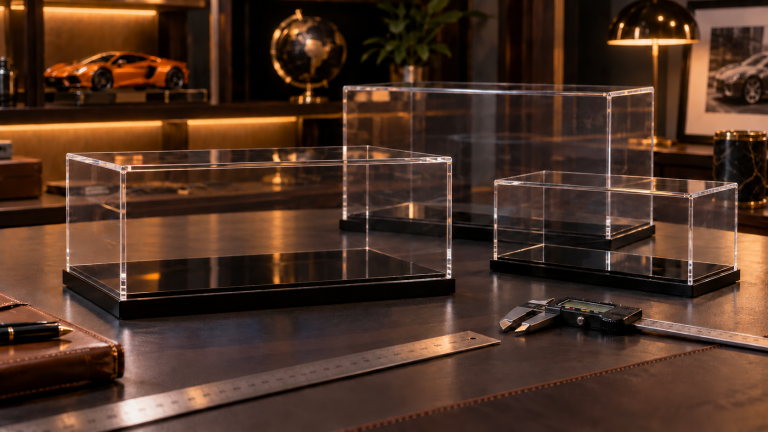
If you are trying to work out how much room a 1:24 model car needs, the short answer is that most passenger cars are roughly 16–20cm long. Larger SUVs, vans and pickups can stretch beyond 20cm, while compact classics and small hatchbacks may be noticeably shorter.
That makes 1:24 an appealing middle-ground scale for collectors. It has more physical presence than 1:43 or 1:64, but it does not consume as much shelf space as a typical 1:18 model. In this guide, we will explain what 1:24 scale actually means, typical dimensions, how much clearance to allow around a model and how to choose a suitable display case.
What does 1:24 scale mean?
A 1:24 model is twenty-four times smaller than the full-size vehicle. Put another way, every 1cm on the model represents 24cm on the real car.
The basic calculation is simple:
Real vehicle dimension ÷ 24 = approximate model dimension.
For example, a real sports car measuring 4.5 metres long is 450cm. Divide that by 24 and the model comes out at approximately 18.75cm long.
This is why there is no single fixed length for every 1:24 model. Scale describes the relationship to the real vehicle, not a universal finished size.
How long is a 1:24 model car?
For most road cars, a useful rule of thumb is around 16–20cm in length. The exact figure depends on the real vehicle being modelled.
| Full-size vehicle type | Typical real length | Approx. 1:24 model length |
|---|---|---|
| Small classic / city car | 3.0–3.8m | 12.5–15.8cm |
| Compact hatchback | 3.9–4.3m | 16.3–17.9cm |
| Sports car / coupé | 4.3–4.7m | 17.9–19.6cm |
| Large saloon | 4.7–5.0m | 19.6–20.8cm |
| SUV / pickup | 4.8–5.4m | 20.0–22.5cm |
These are practical estimates rather than guarantees. Bumpers, splitters, rear wings, spare wheels and other accessories can all affect the final footprint.
How wide is a 1:24 model car?
Many modern passenger cars are roughly 1.75–2.0 metres wide in real life. At 1:24 scale, that works out at approximately 7.3–8.3cm wide.
Mirrors are important when measuring a finished model. If the model has fixed mirrors, use the widest point rather than just the body width. Wide racing bodywork, aerodynamic fins or side accessories can also add a little extra space.
How tall is a 1:24 model car?
A typical road car might be around 1.3–1.7 metres tall. At 1:24 scale, that becomes roughly 5.4–7.1cm high.
Low supercars will sit below that range, while SUVs, vans and off-road vehicles may be taller. If the model has opening doors, a raised bonnet or a display pose that changes its height, allow extra vertical clearance.
How much display space does a 1:24 model car need?
The model itself is only part of the equation. A good display usually looks better when the car is not pressed against the walls of the case.
For a typical 18–20cm-long 1:24 car, allowing a little room around the model helps with presentation and makes it easier to position without catching mirrors or paintwork.
As a general planning guide, consider leaving approximately:
- 2–3cm in front and behind the vehicle.
- 1–2cm on each side beyond the widest point.
- 2–3cm above the tallest point of the model.
That means a model around 19cm long may feel more comfortable in a case with an internal length in the low-to-mid 20cm range rather than a case that is almost exactly 19cm long.
The safest approach is always to measure the exact model first. Do not rely only on the scale printed on the box.
What size display case do I need for a 1:24 model car?
Start by measuring three dimensions: overall length, overall width including mirrors and overall height. Then add presentation clearance rather than choosing a case that only just fits.
For many conventional passenger cars, a case somewhere around 22–25cm internal length can provide a comfortable starting point, but larger 1:24 SUVs, pickups or race cars may require more. Width and height should be chosen in the same way.
If you already own the model, measuring it takes less than a minute and removes the guesswork completely.
Our 1:24 model car display cases are the most relevant place to start when comparing display options for this scale.
1:24 vs 1:18: how much smaller is it?
The difference between 1:24 and 1:18 can be more noticeable than the numbers initially suggest. A model of the same real car is only three-quarters as long at 1:24 as it is at 1:18.
For example, a real 4.5m sports car works out at about 25cm long in 1:18 scale and about 18.8cm long in 1:24 scale.
That reduction applies across length, width and height, so the total display volume drops significantly. If you want more models on the same shelving while still retaining good visual presence, 1:24 can be an attractive compromise.
For a closer look at the larger format, read our guide to how big a 1:18 model car is.
1:24 vs 1:43: which takes more space?
A 1:24 model is considerably larger than a 1:43 version of the same car. A typical 1:43 road car may be around 9–12cm long, while its 1:24 equivalent is often around 16–20cm.
That makes 1:43 easier for very large collections, but 1:24 usually provides stronger shelf presence and makes body shape, wheels and interior details easier to appreciate from normal viewing distance.
You can compare the smaller format in our guide to 1:43 model car dimensions.
1:24 vs 1:64: which scale is better for displaying?
These two scales serve quite different types of collection. A 1:64 car may only be around 6–8cm long, allowing dozens of models to fit into a relatively compact area. A 1:24 model occupies much more room but is capable of becoming a focal display piece rather than simply one item in a dense collection.
If maximum collection density matters, 1:64 has the advantage. If you prefer fewer cars with more visual impact, 1:24 may suit you better.
See our guide to 1:64 model car size and display space for the full comparison.
Why collectors choose 1:24 scale
1:24 sits in a useful middle position. It is large enough for a model to feel substantial on a desk, shelf or cabinet, but compact enough that a collection can grow without immediately taking over a room.
Common reasons collectors choose the scale include:
- Visible detail: wheels, bodywork and interiors are easy to appreciate.
- Manageable footprint: several cars can share a shelf comfortably.
- Good presentation size: a single model still has enough presence to work as a standalone display.
- Wide subject variety: the scale is popular for diecast cars and model kits.
- Balanced collecting: it bridges the gap between compact scales and large premium display models.
Should a 1:24 model be displayed in a case?
A case is not essential, but it can make ongoing care much easier. An enclosed display helps reduce direct dust settlement, casual handling and accidental contact while keeping the model visible.
That can be particularly useful for cars with delicate mirrors, aerials, spoilers or detailed paint finishes.
For more on materials, read our guide to acrylic vs glass display cases. If your priority is long-term care, our guide to protecting model cars from dust, damage and handling covers the practical side in more detail.
How many 1:24 cars fit on a shelf?
It depends on the shelf width and how much visual spacing you prefer. Three cars that are each 18–20cm long will not necessarily require 60cm of shelf width because they are normally displayed side-by-side, so width rather than car length becomes the key measurement.
Measure the width of each model, add a few centimetres between them, and then compare that total with the usable shelf width. Avoid packing cars so tightly that mirrors overlap or removing one model risks knocking another.
Can 1:24 and 1:25 models be displayed together?
Yes. The physical difference between 1:24 and 1:25 is small enough that many collectors are comfortable displaying them together, particularly if the real vehicles are different sizes anyway.
However, if exact scale consistency is important to you, keep the two ratios separate or compare the dimensions before arranging them side by side.
How do you measure a 1:24 model for a display case?
Use a ruler or tape measure and record:
- The full bumper-to-bumper length, including splitters or rear accessories.
- The widest point, normally mirror-to-mirror.
- The highest point, including antennas, roof accessories or raised parts.
Then add your preferred clearance to all three dimensions. If doors, bonnet or boot sections will be displayed open, measure the car in that exact configuration.
Frequently asked questions
How big is a 1:24 model car in centimetres?
Most passenger cars are approximately 16–20cm long, although compact classics can be shorter and large SUVs or pickups can exceed 20cm.
How big is a 1:24 model car in inches?
A typical road car is roughly 6.5–8 inches long. Larger vehicles can reach around 9 inches or more.
Is 1:24 bigger than 1:18?
No. A 1:18 model is larger because the real vehicle is divided by a smaller number. For the same car, a 1:24 model is about 75% of the linear size of the 1:18 version.
Is 1:24 bigger than 1:43?
Yes. A 1:24 model is significantly larger than a 1:43 model of the same vehicle and requires more display space.
What is the best display case size for a 1:24 car?
There is no universal case size because real vehicles differ. Measure your model first and allow a few centimetres of clearance around it. For many typical passenger cars, an internal case length in the low-to-mid 20cm range is a sensible starting point.
Choosing the right display for your 1:24 collection
The most important lesson is that 1:24 describes a ratio, not a fixed physical size. Most passenger cars fall around 16–20cm long, but the actual model can be smaller or larger depending on the vehicle.
Measure before buying a case, include mirrors and accessories, and leave enough breathing room for the car to look intentional rather than squeezed into the enclosure.
Explore our 1:24 model car display cases, or browse the wider Model Car Display Cases hub. For a broader overview of the main collecting scales, see our 1:64 vs 1:43 vs 1:24 vs 1:18 scale comparison guide.