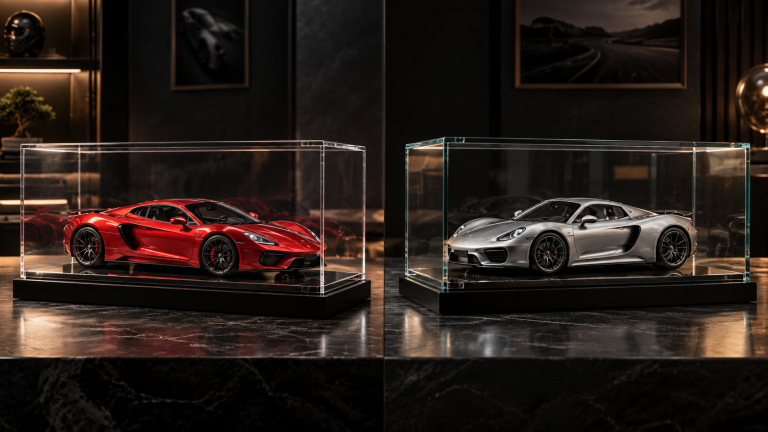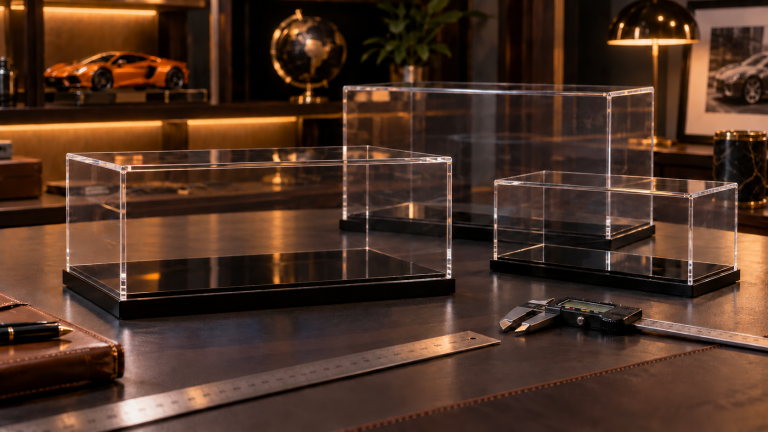
Choosing the right display case for a model car sounds simple until you start comparing scales, internal dimensions, materials, mounting styles and multi-car options. A case that looks right in a product photograph may be too tight for your particular model, too deep for your shelf or simply wrong for the way you want your collection to grow.
The best approach is to choose the display around the model, the available space and the way you collect — rather than choosing a case by scale alone. This guide explains the main decisions to make before buying, from measuring the car and allowing sensible clearance to deciding between acrylic and glass, single-car and multi-car displays, and freestanding or wall mounted formats.
If you are still deciding which model scale suits your collection, start with our model car scale comparison guide. If you already know the model you want to display, the checklist below will help you narrow down the right case.
Start With the Model, Not the Display Case
The most common mistake is to assume that every model labelled 1:18, 1:24, 1:43 or 1:64 has exactly the same dimensions. Scale tells you the relationship between the model and the full-size vehicle, but the real vehicle itself may be a compact sports car, a large saloon, an SUV, a van or a racing prototype.
That means two models in the same scale can have noticeably different lengths, widths and heights. Accessories can change the footprint too. Large rear wings, mirrors, roof boxes, aerials, opening doors or display plinths can all require additional clearance.
Before choosing any case, identify the exact model you are displaying and measure it. Treat the advertised scale as a useful starting point, not a guarantee of fit.
Measure Length, Width and Height
Use a ruler or tape measure to record the model’s overall length, width and height. Measure the furthest points rather than only the main bodywork. For example, include wing mirrors in the width and a rear spoiler in the length or height where appropriate.
If the model sits on its own manufacturer-supplied base and you intend to keep that base in the display, measure the base as well. The case needs to accommodate whichever footprint will actually sit inside it.
Do not choose a case that exactly matches the model
A display case normally looks better when there is some visual breathing room around the car. A model squeezed close to the acrylic walls can feel cramped and may be awkward to position without touching the sides.
The right amount of clearance depends on the design of the display and your preference, but the principle is straightforward: the internal usable dimensions of the case need to be comfortably larger than the model itself.
We will cover case-sizing calculations in more detail in our dedicated guide, What Size Display Case Do I Need for My Model Car?, later in this series.
Use Scale as a Shortcut — Then Check the Actual Dimensions
Scale-specific display cases are useful because they are designed around the typical proportions of models in that category. They can save a lot of guesswork, particularly when your collection mainly contains conventional passenger cars.
Our existing size guides explain the typical footprint of the four scales we currently focus on:
- 1:64 model cars — compact and well suited to larger collections and multi-car displays.
- 1:43 model cars — a popular collector scale balancing detail with manageable display space.
- 1:24 model cars — larger models that benefit from more generous shelf depth and surrounding space.
- 1:18 model cars — substantial hero models that can become a display feature in their own right.
Once you know the scale, browse the relevant model car display cases, but still compare the product’s usable dimensions with your individual model before ordering.
Decide Whether You Want a Single-Car or Multi-Car Display
The next question is not about size at all — it is about how you want the collection to look.
Single-car display cases
A single-car case works well when the model is important enough to stand alone. This may be a favourite road car, a rare release, a signed model, a limited edition or simply a car with a colour and shape that deserves its own visual space.
Individual cases can also make a collection feel more gallery-like because each model has a defined boundary. They are particularly effective for larger 1:18 and 1:24 cars.
Multi-car display cases
A multi-car display case can be the better option when the relationship between the cars matters. Racing grids, one manufacturer, a generation of the same model, a motorsport team or a themed colour collection can all look stronger when displayed together.
Grouped displays also make efficient use of space. Instead of placing several individual cases next to one another, one larger enclosure can provide a more consistent appearance and reduce visual clutter.
For compact scales such as 1:64, multi-car displays become especially useful because collectors can accumulate dozens of models relatively quickly.
Freestanding or Wall Mounted?
Your room can be just as important as the model. Before choosing a case, decide where the finished display will actually live.
Freestanding display cases
Freestanding cases are the obvious choice for shelves, desks, cabinets and sideboards. They are easy to reposition as the collection changes and can usually be viewed from several angles.
Check the available shelf depth carefully. Larger-scale cases can occupy more room than expected once the clear enclosure and base are included.
Wall mounted displays
If shelves are becoming crowded, wall mounted car displays can turn unused vertical space into part of the collection. They can also make a large group of smaller models feel like a deliberate room feature rather than storage.
Wall mounted options make particular sense for growing collections, but always check the product’s mounting requirements and make sure the wall and fixings are appropriate for the finished display.
Choose the Right Display Material
Clear display cases are commonly made from acrylic or glass. Both can create an excellent presentation, but they behave differently in everyday use.
Acrylic is lightweight, clear and practical for made-to-order displays. It is less likely to shatter than conventional glass and is particularly useful for larger cases and wall mounted formats. It does, however, need sensible cleaning because abrasive cloths or unsuitable cleaners can mark the surface.
Glass has a heavier, more traditional feel and generally offers better resistance to everyday scratching, but the additional weight can make large or wall mounted displays less convenient.
We compare the two materials in detail in Acrylic vs Glass Display Cases: Which Is Best for Model Cars?.
Do not assume that either material provides UV protection unless the product specification explicitly says so. If light protection is important for a particular collectible, check the material specification rather than relying on the word acrylic or glass alone.
Think About the Base and Background
The clear enclosure protects the viewing area, but the base and background often determine how premium the finished display feels.
A simple dark base can work with almost any model because it creates contrast without competing with the car. Bright or heavily patterned backgrounds can be effective for themed collections, but they should support the model rather than overwhelm it.
Printed backdrops can work particularly well for motorsport scenes, workshop environments, circuit-inspired displays or personalised collections. When choosing one, consider whether you want the display to feel timeless or highly specific to that particular car.
If you frequently rotate the models in your displays, a more neutral base and backdrop may give you greater flexibility.
Consider How Often You Will Access the Model
Some collectors place a model in a case and rarely touch it again. Others regularly rotate their collection, photograph cars, inspect details or move models between displays.
If you plan to access the car often, consider how the enclosure opens or lifts away and whether there is enough room to remove the model comfortably. A display can look excellent but become frustrating if every change requires awkward handling.
Reducing unnecessary handling is also one of the easiest ways to protect delicate mirrors, aerials, paint finishes and small components. Our guide to protecting model cars from dust, damage and handling covers this in more detail.
Plan for the Collection You Will Have Next Year
Collectors rarely stop at one model. If you already know that you are building a particular manufacturer, racing series, colour theme or scale, it is worth thinking beyond the car currently on your desk.
A consistent display system can make a growing collection look far more intentional. Matching bases, similar case heights and repeatable spacing create visual order even when the cars themselves are completely different.
For collectors who expect significant growth, a multi-car or wall mounted format can sometimes make more sense than buying individual cases one at a time.
When Should You Choose a Custom Display Case?
Standard scale-specific cases work for many collections, but some models simply fall outside normal proportions. A custom case may be worth considering when:
- the model is unusually long, wide or tall for its scale;
- you want to retain a large manufacturer display plinth;
- the model includes an oversized spoiler, aerial or accessory;
- you want several different scales in one display;
- the available shelf or alcove has unusual dimensions;
- you want a personalised backdrop or presentation built around one particular collectible.
Our custom display cases are intended for situations where a standard format is not the best fit.
Model Car Display Case Buying Checklist
Before ordering, work through this quick checklist:
- Measure the model at its furthest length, width and height.
- Include the original base if it will remain under the model.
- Check internal dimensions, not just the external size of the display.
- Allow visual clearance rather than choosing an exact fit.
- Decide between single and multi-car presentation.
- Measure the shelf, desk or wall space where the finished display will go.
- Choose the material based on weight, scratch resistance and how the case will be used.
- Consider future models if you are building a larger collection.
- Check access and mounting requirements before ordering.
- Choose custom sizing if the model falls outside normal proportions.
Which Display Case Is Best for Your Model Car?
There is no single best case for every collector. The right choice is the one that fits the actual model, gives it enough visual space, works in the room and suits the way you intend to build the collection.
For a single larger model, a dedicated scale-specific acrylic case is often the simplest option. For a growing compact collection, a multi-car or wall mounted display may use space more efficiently. For unusual dimensions or a highly personalised presentation, a custom display can remove the compromises of a standard format.
The key is to treat scale as the starting point and actual measurements as the final decision. Browse our model car display cases to compare the available formats, then check each product’s dimensions and compatibility before ordering.
Frequently Asked Questions
Should a model car display case be bigger than the model?
Yes. The internal dimensions should be larger than the car so the model is easy to position and has some visual breathing room around it. Avoid choosing a case that matches the car’s measurements exactly.
Can I choose a display case based only on model scale?
Scale is a useful shortcut, but it should not be the only measurement you use. Cars within the same scale can vary considerably because the full-size vehicles differ in length, width and height.
Is acrylic or glass better for model cars?
Neither is universally better. Acrylic is lighter and less likely to shatter, making it practical for many collector displays. Glass generally resists scratches better and has a heavier traditional feel. The right choice depends on the display size, location and how often it will be handled.
Are multi-car display cases better than individual cases?
They can be for themed or growing collections. A multi-car case uses space efficiently and can create a stronger grouped presentation, while individual cases give each model its own defined display area.
When do I need a custom model car display case?
Consider a custom case when the model is unusually sized, sits on a large plinth, includes oversized accessories, needs to fit a specific shelf or alcove, or you want a highly personalised presentation.
How do I know if a case will fit on my shelf?
Compare the display’s external dimensions with the usable width, depth and height of the shelf. Remember to leave enough room to place and remove the case safely, especially if the enclosure lifts vertically from the base.