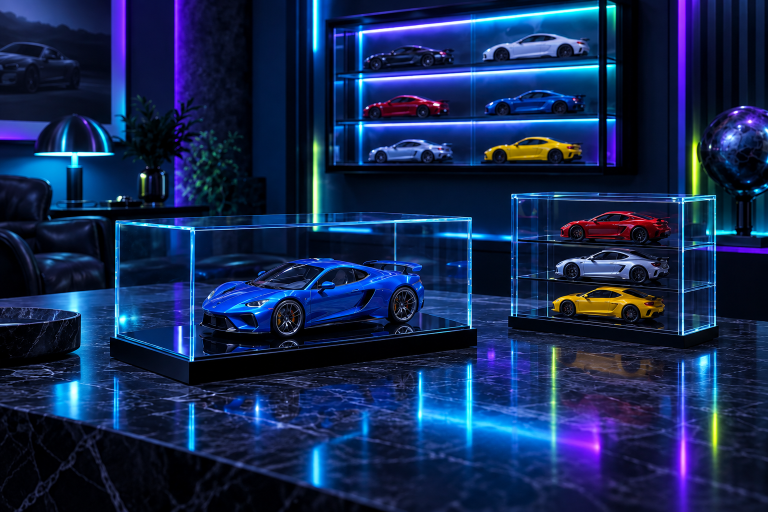

Model cars are often bought because of what they represent. It might be a favourite road car, a racing legend, a childhood memory or simply a model whose detailing is too good to leave hidden away in its box.
Once a collection begins to grow, displaying it properly becomes an important part of the hobby. A good display case does more than make a collection look better: it helps protect models from dust, reduces unnecessary handling and gives each car a dedicated place where it can be appreciated.

What is a model car display case?
A model car display case is an enclosed or partially enclosed display designed to present scale vehicles while providing a layer of protection from everyday dust, knocks and handling. The most common modern designs use clear acrylic panels or covers combined with a solid base, backing panel or wall mounting system.
They can be designed for a single important model, several cars displayed together or an entire collection arranged across a wall. The right choice depends on the scale of the models, the amount of space available and the way you want the collection to feel in the room.
Collector shortcut
Start with the model, not the case
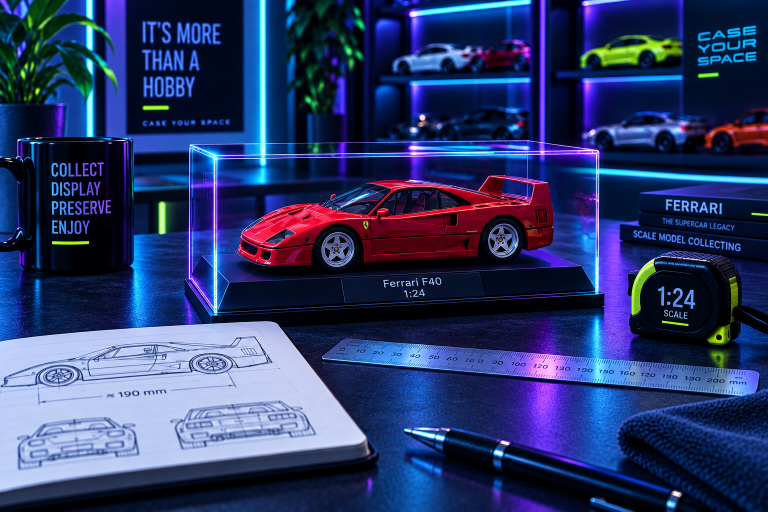
Always measure the model you actually own before choosing a display. Scale is a useful starting point, but two cars at the same scale can have noticeably different lengths and widths because the real vehicles are different sizes.
Why use a display case for model cars?
There is nothing wrong with placing a model directly on a shelf, but collectors quickly discover the disadvantages. Dust settles into panel lines, grilles, wheels and interiors; models are moved during cleaning; and a growing collection can begin to look cluttered rather than curated.
A dedicated case creates a defined visual boundary around the model. That small change can make a single car feel more like a display piece while helping a larger collection look intentional.
Dust protection
An enclosed display substantially reduces the amount of dust settling directly onto a model. It does not turn the display into an airtight environment, but it can reduce how frequently detailed models need to be cleaned.
Less unnecessary handling
The less frequently a model has to be moved, the lower the chance of mirrors, aerials, spoilers or other delicate details being caught during routine cleaning. Once the model is positioned inside a case, the exterior of the display can usually be cleaned without touching the car itself.
Better presentation
Presentation matters to collectors. A clear cover, consistent base and considered spacing around the model can create the same visual effect you see in museums, showrooms and premium retail displays.
Understanding model car scales
Scale describes how much smaller the model is than the real vehicle. A 1:18 model is eighteen times smaller than the real car, while a 1:64 model is sixty-four times smaller. The lower the second number, the larger the model will generally be.
| Scale | Typical car length | Best suited to |
|---|---|---|
| 1:64 | Approx. 6–8 cm | Large collections, compact displays and multi-car arrangements |
| 1:43 | Approx. 9–12 cm | Collectors wanting more detail without using a large amount of space |
| 1:24 | Approx. 17–20 cm | Mid-sized feature models and more prominent shelf displays |
| 1:18 | Approx. 23–30 cm | Larger, highly detailed models intended to become focal pieces |
These measurements are only a guide. A 1:18 city car will naturally be shorter than a 1:18 limousine or large performance car, so the dimensions of the individual model should always take priority.
Compact collections
1:64 model cars
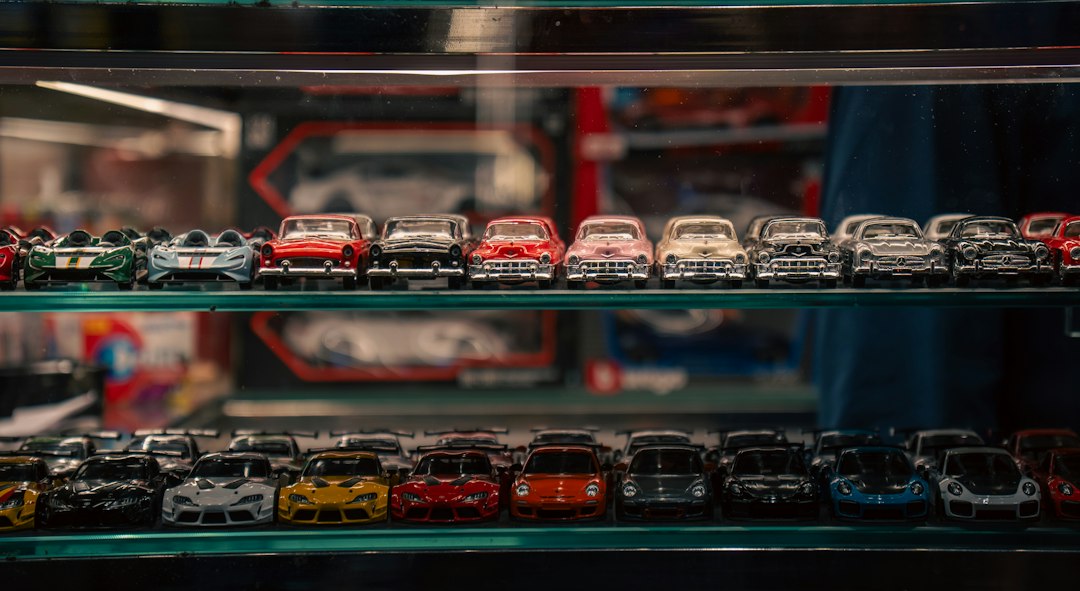
Ideal when you want to display a larger number of cars without taking over the room. Consistent spacing and multi-car displays work particularly well at this scale.
Balanced detail
1:43 model cars
A popular middle ground that provides more visible detail while remaining compact enough for substantial collections.
Feature models
1:24 model cars
Large enough to command attention but still manageable on shelves, desks and dedicated furniture.
Statement pieces
1:18 model cars
Often chosen for premium models with significant exterior and interior detail, making the display itself more important.
How to choose the right model car display case
The best display is not necessarily the largest or most elaborate. It is the one that suits the model, the room and the way you collect. Before buying, think about the following four points.
1. Measure the model
Measure the overall length, width and height of the model, including mirrors, spoilers, aerials and openable components that you may want to display in a particular position. Allowing some breathing room around the car usually creates a more premium appearance than a case that fits too tightly.
2. Decide whether the model is the hero or part of a collection
A particularly important car often benefits from its own display. By contrast, a themed collection may look better when several cars are intentionally grouped together. The display should support the story you are trying to tell.
3. Choose where the display will live
A desk, shelf, sideboard and wall all create different constraints. Consider viewing height, available depth and whether the display needs to be moved in future.
4. Think about how your collection may grow
Collectors rarely stop at one model. If you already know that you collect a particular manufacturer, racing series or scale, choosing a repeatable display format can make future additions look much more cohesive.
Single-car or multi-car display?
Single-car and multi-car displays serve different purposes, and neither is automatically better.
Single-car displays
A single-car case gives one model maximum visual focus. This works particularly well for a flagship model, a gift, a signed piece or a car with personal significance. The space around the model becomes part of the presentation.
Multi-car displays
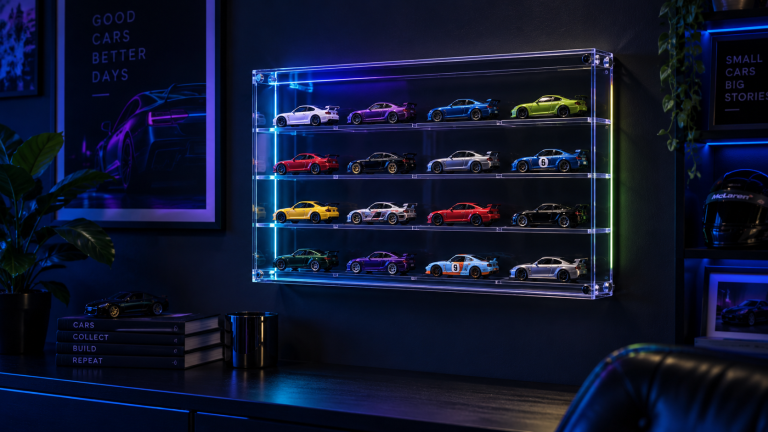
Multi-car displays make efficient use of space and can turn several individual models into one collection. Cars can be arranged by manufacturer, motorsport series, colour, era or scale.
A good collection display should make it easy to understand what connects the cars without needing an explanation.
Freestanding vs wall mounted displays
The location of the collection often determines the best display style. Freestanding cases are simple to reposition and work naturally on shelving, desks and sideboards. Wall mounted displays use vertical space and can turn a collection into part of the room itself.
When freestanding works best
Choose a freestanding case when you want flexibility, regularly reorganise the collection or have suitable furniture already in place. Individual cases can also create a strong showroom feel when aligned consistently.
When wall mounted works best
Wall mounted displays are useful when shelf space is limited or when the collection deserves to become a feature. Larger collections can be easier to appreciate at eye level rather than being spread across several pieces of furniture.
Display idea
Turn the collection into part of the room
A carefully arranged wall can work particularly well for 1:64 and 1:43 collections where many cars need to be presented without using valuable floor or shelf space.
Acrylic vs glass display cases
Both materials can provide a clear enclosure, but they behave differently. Acrylic is much lighter than glass and is widely used for collector displays because it can be precisely cut and formed into clean, contemporary shapes. Glass has a familiar premium feel but is heavier and more vulnerable to breakage.
For model cars, the best choice will depend on the size of the display, where it will be positioned and how often it may need to be moved. We will cover this comparison in more detail in a dedicated acrylic-versus-glass guide.
How to protect model cars from dust and handling
A display case is one part of caring for a collection. Positioning and cleaning habits matter too. Avoid repeatedly lifting delicate cars simply to clean the surrounding shelf, use a soft method when dusting the exterior of the display and avoid overcrowding models so closely that they have to be moved every time one is removed.
If a model is especially valuable or delicate, think about where the display is positioned in relation to busy walkways, children, pets and places where objects are frequently moved around.
Common model car display mistakes
Most display problems come from choosing the case before considering the collection. The following mistakes are easy to avoid:
- Relying only on scale. Always check the actual dimensions of the model.
- Overcrowding. More cars do not always create a better display. Give important models visual space.
- Ignoring the room. A great case in the wrong location can still feel awkward.
- Mixing scales without intention. Different scales can work together, but the layout should feel deliberate.
- Forgetting future additions. A repeatable system makes a growing collection much easier to organise.
Frequently asked questions
What size display case do I need for a 1:18 model car?
Measure the actual model and choose a case that provides comfortable clearance around the bodywork, mirrors and any other projecting details. Because full-size vehicles differ significantly in size, there is no single external dimension that suits every 1:18 model.
Are acrylic display cases good for model cars?
Yes. Acrylic is commonly used for collector displays because it combines clarity with relatively low weight and can be manufactured in a wide range of formats.
Do display cases completely stop dust?
No normal household display should be treated as completely airtight, but an enclosed case can greatly reduce the amount of dust landing directly on the model compared with an exposed shelf.
Should model cars stay in their original boxes?
That depends on how you collect. Some collectors prioritise original packaging, while others want to enjoy seeing the model itself. A display case gives you the option to showcase the car while still giving it additional protection.
Display what matters
Your collection represents cars you chose for a reason. Whether you are displaying one important 1:18 model or organising dozens of 1:64 cars, the display should become part of the collection rather than an afterthought.
Case Your Space creates premium display solutions designed to protect and present the things collectors love. Explore our range of Model Car Display Cases, discover Wall Mounted Car Displays or explore a Custom Display Case for something more specific.