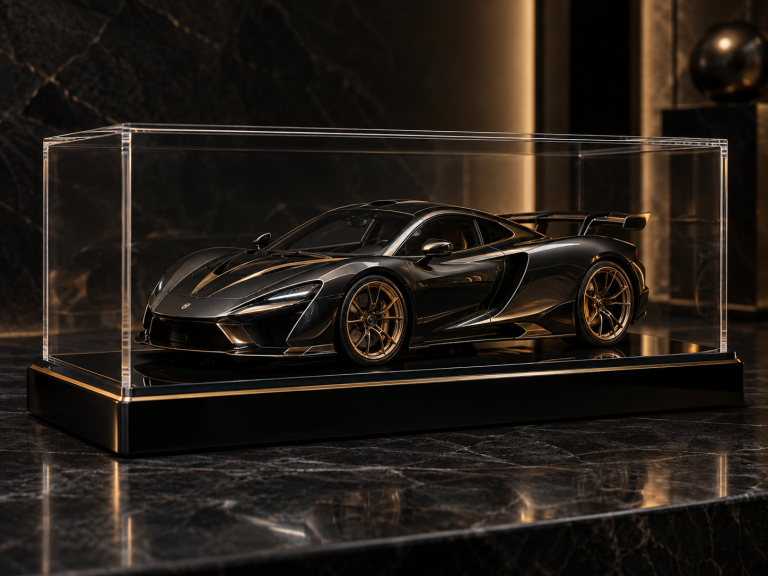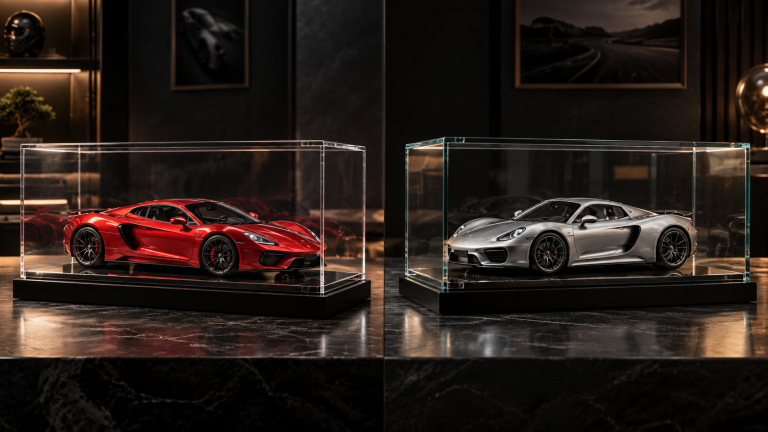
1:64 is one of the most space-efficient model car scales, which is a big reason it has become so popular with collectors. The cars are small enough to build a large collection without needing a dedicated room, but still large enough for body shape, wheels, liveries and other details to remain recognisable at a glance.
So how big is a 1:64 model car in real terms? For a typical passenger car, you can usually expect a model around 6 to 8 centimetres long, roughly 2.5 to 3.5 centimetres wide and around 2 to 3 centimetres high. Those figures are useful starting points rather than fixed rules, because the size of the real vehicle still determines the size of the model.
What does 1:64 scale mean?
A 1:64 model represents the full-size vehicle reduced to one sixty-fourth of its real dimensions. In simple terms, every 64 units on the real car become one unit on the model.
If a real car is 4.5 metres long, that is 450 centimetres. Divide 450 by 64 and the model would be approximately 7 centimetres long. The same calculation can be used for width and height.
Quick calculation
How to estimate the size of a 1:64 model
Real vehicle dimension ÷ 64 = approximate model dimension.
A 4.5 m car becomes roughly 7.0 cm long at 1:64 scale. A 1.8 m wide car becomes roughly 2.8 cm wide.
This is why there is no single universal length for every 1:64 model. A supermini, estate car, van, pickup and limousine can all be sold as 1:64 while having noticeably different footprints.
Typical dimensions of a 1:64 model car
Most 1:64 passenger-car models sit within a fairly compact range, which makes the scale easy to organise in repeatable rows and display systems.
| Dimension | Typical 1:64 size | What changes it? |
|---|---|---|
| Length | Approx. 6–8 cm | Real vehicle length, overhangs and bumpers |
| Width | Approx. 2.5–3.5 cm | Body width, mirrors and wide arches |
| Height | Approx. 2–3 cm | Roofline, ride height, roof accessories |
Sports cars often sit toward the lower end of the height range, while SUVs, vans and off-road vehicles can be taller. Long-wheelbase cars, transporters and pickups may also exceed the usual length range.
Why some 1:64 models are bigger than others
The scale number describes the relationship to the real vehicle, not a standard box size. Two models can both be accurately produced at 1:64 and still look very different next to each other.
A full-size city car may be less than four metres long, while a large pickup can exceed five metres. When both are reduced by the same factor, the pickup will still be physically larger.
Real vehicle dimensions
This is the biggest factor. The longer, wider or taller the real vehicle, the larger the model will be at the same scale.
Mirrors, wings and accessories
Mirrors, splitters, spoilers, roof boxes, light bars and other details can increase the model’s overall footprint. These are easy to overlook when measuring for a close-fitting display.
Manufacturer interpretation
Not every small diecast car is produced to an exact mathematical scale. Some ranges use approximately 1:64 proportions while making minor adjustments so vehicles work within a standard package or wheel format. If an exact fit matters, measure the physical model rather than relying only on the scale printed on the packaging.
How much display space does a 1:64 model need?
A model may only be 7 centimetres long, but a good display should not be designed to the exact footprint of the car. Leaving space around each model makes the collection easier to see and prevents the display from feeling overcrowded.
For a single typical car, a useful starting point is to allow approximately:
- 9–11 cm of internal length so there is clear space in front of and behind the car.
- 5–6 cm of internal depth so the sides and mirrors do not sit against the case.
- 4–5 cm of internal height for a normal passenger car, with extra clearance for taller vehicles.
These are display-planning allowances, not universal case specifications. Measure your actual model first, especially if it is a van, truck, SUV or unusually long vehicle.
Single car
Give it breathing room
A small amount of clear space around the model makes even a compact 1:64 car feel more deliberate and premium.
Multi-car display
Plan repeatable spacing
Consistent gaps between cars create cleaner rows and make the collection easier to expand later.
Wall display
Use vertical space
1:64 is particularly well suited to wall mounted layouts because dozens of cars can fit into a relatively small footprint.
Large collection
Think modular
Repeatable shelf heights and sections help prevent a growing collection from becoming visually chaotic.
How many 1:64 cars can fit on a shelf?
The answer depends on the shelf width, whether the cars are displayed nose-to-tail or side-by-side, and how much space you leave between them.
If each model uses around 9 centimetres of horizontal display width including spacing, a one-metre shelf could hold roughly ten or eleven cars in a single row. Tighter layouts may fit more; more generous presentation may fit fewer.
Depth matters too. A shelf around 12 to 15 centimetres deep can often accommodate more than one row of 1:64 cars, but rear rows may become harder to see unless the display is tiered.
Is 1:64 a good scale for large collections?
Yes. In practical terms, 1:64 is one of the easiest scales for collectors who expect their collection to grow into dozens or hundreds of cars.
The advantages are straightforward:
- Many cars can be displayed in a relatively small area.
- Multi-car cases can organise collections by manufacturer, colour, era, motorsport series or theme.
- Wall-mounted displays can use vertical space instead of consuming desks and shelves.
- Collections are easier to rearrange when a new model arrives.
- It is possible to keep a consistent display system even as the collection grows.
The main challenge is density. Because the cars are small, it is tempting to keep adding them until every gap disappears. A little negative space usually improves the overall presentation.
1:64 vs 1:43, 1:24 and 1:18
The jump from 1:64 to larger model-car scales is significant. A 1:43 model is noticeably larger, while 1:24 and 1:18 cars need substantially more shelf depth and spacing.
| Scale | Typical passenger-car length | Display character |
|---|---|---|
| 1:64 | Approx. 6–8 cm | Compact, high-capacity collections |
| 1:43 | Approx. 9–12 cm | Balance of size and detail |
| 1:24 | Approx. 17–20 cm | Mid-sized feature models |
| 1:18 | Approx. 23–30 cm | Large statement pieces |
For a broader comparison, see our Model Car Scale Comparison Guide.
What size display case should you use for a 1:64 model?
Start with the model itself. Measure its maximum length, width and height, including mirrors, spoilers and any other protruding details. Then choose a case with enough additional room to create a clear border around the car.
For many standard passenger cars, an internal display space somewhere around 9–11 cm long, 5–6 cm deep and 4–5 cm high can provide comfortable clearance. However, those figures should never replace measuring the actual model.
Before ordering a case
Measure the widest, longest and tallest points
Do not measure only the body shell. Include mirrors, spoilers, roof accessories and any base the model is permanently attached to.
Single-car or multi-car case?
Single-car displays
A single-car case works best when one model has particular importance: a favourite road car, a rare release, a race winner, a gift or a miniature version of a car you own. The extra space around one small model can make it feel much more significant.
Multi-car displays
Multi-car cases make more sense when the collection itself is the feature. 1:64 is particularly suited to this because a relatively modest case can hold several cars without becoming excessively large.
Grouping models consistently can also create stronger visual stories: one manufacturer, one championship, one decade, one colour theme or a complete casting series.
Should 1:64 cars be displayed on a wall?
For collectors who are short on shelf space, wall mounting can be one of the most efficient ways to display 1:64 models. The cars are lightweight and compact, so a wall display can hold a substantial number without needing the depth associated with larger scales.
A wall layout also turns the whole collection into part of the room rather than hiding it inside a cabinet. If you plan to build a large wall, use consistent spacing and leave room for future sections so the display can expand without needing to be rebuilt.
How to make a 1:64 collection look more premium
Small models benefit from intentional presentation. When dozens of cars are displayed together, consistency becomes more important than any one individual case.
- Keep spacing consistent. Equal gaps make rows look cleaner.
- Group with a purpose. Manufacturer, era, colour, racing series or body style all work well.
- Avoid overcrowding. Leave enough empty space for individual cars to be visually separated.
- Use a consistent background. A dark, neutral or uncluttered backdrop helps small models stand out.
- Keep the display clean. Dust is much more obvious when many small glossy models are grouped together.
- Plan for growth. Choose a system that can be repeated when the collection expands.
Frequently asked questions
How long is a 1:64 model car?
Many 1:64 passenger cars are around 6 to 8 centimetres long. Smaller real cars may produce shorter models, while vans, pickups, limousines and larger vehicles can be longer.
How wide is a 1:64 model car?
A typical passenger car is often around 2.5 to 3.5 centimetres wide at 1:64 scale, although mirrors and wide bodywork can increase the overall measurement.
How tall is a 1:64 model car?
Many road cars are approximately 2 to 3 centimetres tall. SUVs, vans, trucks and vehicles with roof accessories can be taller.
Is Hot Wheels 1:64 scale?
Many small diecast cars are commonly described as being around 1:64 scale, but exact scale can vary between individual castings and manufacturers. If exact dimensions matter for a display case, measure the physical model rather than assuming every car sold in the same range has identical proportions.
Is 1:64 smaller than 1:43?
Yes. A 1:64 version of the same real vehicle is smaller than a 1:43 version. In scale ratios, the larger denominator represents the smaller model.
What is the best display case size for 1:64 cars?
There is no one universal size. For a typical passenger car, allowing roughly 9–11 cm of internal length, 5–6 cm of depth and 4–5 cm of height can provide comfortable presentation space, but the correct case should always be chosen from the model’s actual measurements.
Small scale, big collection potential
1:64 is compact enough for serious collection building without demanding huge amounts of space. A single model may only be around seven centimetres long, but thoughtful spacing, organisation and protection can make an entire group feel far more substantial.
If you are planning a display, measure the models you already own and think about how quickly the collection is likely to grow. A repeatable system is usually more useful than squeezing the maximum number of cars into the smallest possible footprint.
For more advice, read our Complete Guide to Model Car Display Cases, compare the most popular sizes in our Model Car Scale Comparison Guide, or browse our Model Car Display Cases.