If you are buying your first large-scale diecast or planning a proper display, one question matters immediately: how big is a 1:18 model car? The short answer is that most 1:18 passenger cars are roughly 23–30 cm long, but the exact dimensions depend on the full-size vehicle being reproduced.
That variation matters when you are choosing shelving, planning a collection or buying a display case. A compact hatchback, supercar, estate, Formula 1 car and pickup truck can all be 1:18 scale while needing very different amounts of space.
Quick answer
What size is a typical 1:18 model car?
Most 1:18 passenger-car models are approximately 23–30 cm long, around 10–13 cm wide and commonly 6–10 cm high. Those figures are only a guide. The actual dimensions of the real vehicle determine the finished model size, so larger SUVs, limousines, trucks and race cars with wide wings can fall outside those ranges.
What does 1:18 scale actually mean?
A 1:18 model is one eighteenth of the size of the real vehicle in each linear dimension. Put simply, 18 centimetres on the real car become 1 centimetre on the model.
If a real car is 4.5 metres long, convert that to 450 cm and divide by 18:
450 cm ÷ 18 = 25 cm
So a faithful 1:18 version of that car should be roughly 25 cm long.
The important point is that 1:18 is a ratio, not a fixed model size. Two completely different cars at 1:18 scale will not necessarily share the same length, width or height.
Typical 1:18 model car dimensions
For standard passenger cars, these ranges are a useful starting point when planning storage or display space:
| Measurement | Typical 1:18 model range | Why it varies |
|---|---|---|
| Length | Approx. 23–30 cm | Full-size wheelbase, body style and overhangs |
| Width | Approx. 10–13 cm | Body width, mirrors, wheel arches and aero parts |
| Height | Approx. 6–10 cm | Supercar, saloon, SUV or competition-car body shape |
These are not case dimensions and they should not be treated as guaranteed measurements for every model. A display case needs additional clearance around the car, while some models include mirrors, wings, aerials or opening panels that extend beyond the basic body dimensions.
Why are some 1:18 model cars much bigger than others?
The easiest way to understand the difference is to think about the real vehicles themselves. A compact city car may be around four metres long, while a luxury saloon, pickup truck or long-wheelbase grand tourer can be substantially longer. Reduce both by the same factor of 18 and the difference remains.
Compact cars
Often at the smaller end
Short hatchbacks and compact classics can sit comfortably below the average length of a larger 1:18 model.
Sports & supercars
Low, wide and visually substantial
They may not be especially tall, but wide tracks, mirrors and aerodynamic features can increase the required case width.
Saloons & GT cars
Often around the middle of the range
Longer bodywork can make these models noticeably larger than compact cars despite sharing the same scale.
SUVs, trucks & long vehicles
Can exceed typical assumptions
These can require extra length, width and height, so relying on the scale label alone is risky.
How to calculate the expected size of a 1:18 model
If you know the real car’s dimensions, you can estimate the model before you buy it. Divide the real-world measurement by 18, keeping the units consistent.
For example, take a car that is:
- 4,500 mm long
- 1,800 mm wide
- 1,260 mm high
At 1:18 scale, the approximate model dimensions would be:
- Length: 4,500 ÷ 18 = 250 mm
- Width: 1,800 ÷ 18 = 100 mm
- Height: 1,260 ÷ 18 = 70 mm
That gives you a model around 25 × 10 × 7 cm. Manufacturing tolerances, mirrors, spoilers, tyre position and decorative parts can alter the final footprint slightly, but the calculation gives you a very useful planning figure.
How much shelf space does a 1:18 model car need?
A common mistake is to measure the car and allocate exactly the same amount of shelf space. Technically the model may fit, but visually it can look cramped and become awkward to handle.
For a single 1:18 car, aim to leave visible space around every side. If a model is 27 cm long and 12 cm wide, a shelf that is only 27 × 12 cm gives you virtually no practical margin. You also need to consider how you will place the car down, remove dust around it or lift a cover over it.
For open shelving, it is sensible to allow several centimetres of breathing room around the model. For enclosed displays, the internal dimensions of the case matter — not merely the overall external size.
What size display case do I need for a 1:18 model car?
There is no universal case size that fits every 1:18 vehicle, but many standard passenger-car displays sit somewhere around the low-30cm internal length range. That is why cases designed around roughly 30–32 cm of usable internal length are commonly marketed for 1:18 cars.
The safer method is always:
- Measure the actual model from its furthest front point to its furthest rear point.
- Measure the widest point, including mirrors, tyres or wings.
- Measure the highest point, including aerials or raised bodywork.
- Add comfortable visual clearance on every side.
- Compare those measurements with the case’s internal usable dimensions.
Case planning
Do not buy by scale alone
A case labelled for 1:18 cars may fit most conventional models but still be too tight for a long limousine, wide race car, pickup or model displayed with doors open. Measure first whenever the exact dimensions are available.
How much clearance should you leave inside a display case?
There is no mandatory clearance figure because presentation is subjective, but a model generally looks better when the acrylic is not sitting visually tight against the bumpers, mirrors or roofline.
As a practical starting point, leaving roughly 2–4 cm of additional internal length beyond the model and a little clear space on each side usually creates a more considered display. Large wings, open doors or unusually wide mirrors may need more.
The aim is not simply to make the car fit. The aim is to frame it properly.
Do opening doors and bonnets change the case size you need?
They can. Many larger diecast models include opening doors, bonnets, boots or engine covers. If you intend to display those parts open, measure the model in that exact position.
An upward-opening door can significantly increase height. A conventional door can increase total width. An open bonnet may need extra vertical and forward clearance.
If you usually display the car closed, choose your case around the closed dimensions. If an open configuration is part of the presentation, size the case for the largest footprint the model will occupy.
Is a 1:18 model car too big for a normal bookshelf?
It depends on the shelf, but depth is often the limiting factor rather than width. A model that is 25–30 cm long may fit easily along a shelf, yet a car around 11–13 cm wide still needs space behind and in front of it if the display is to look intentional.
Bookshelves can work very well for 1:18 collections where the shelves are deep enough. However, once several cars are displayed together, spacing becomes important. Three large models placed shoulder-to-shoulder require considerably more room than their raw widths suggest.
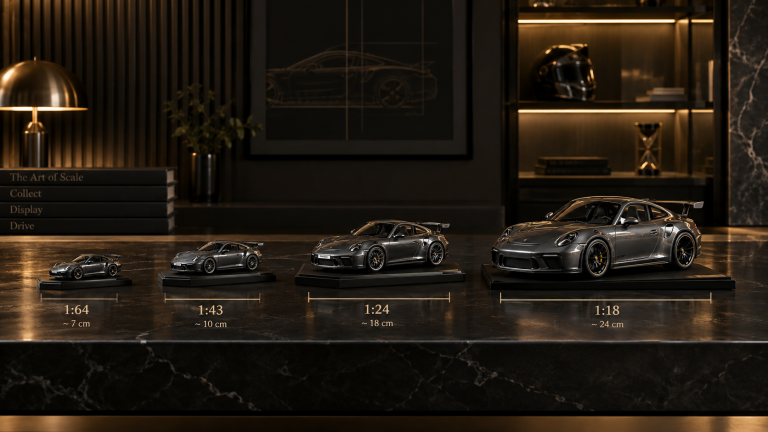
1:18 vs 1:24: how much bigger is a 1:18 model?
A 1:18 model is noticeably larger than a 1:24 version of the same vehicle. Because scale affects every dimension, the difference is more dramatic than simply comparing 18 with 24.
A car that would be 27 cm long at 1:18 scale would be roughly 20 cm long at 1:24. That extra length is immediately noticeable on a shelf, while the increased width and height give a 1:18 model much greater visual presence.
If you are still deciding which scale suits your space, our model car scale comparison guide compares 1:64, 1:43, 1:24 and 1:18 side by side.
Are 1:18 model cars good for display?
For many collectors, display presence is exactly why 1:18 is so appealing. The larger physical size makes body lines, wheels, interiors and fine exterior details easier to appreciate from normal viewing distance.
The trade-off is space. A 1:18 collection can outgrow casual shelving quickly, particularly when each car is given enough room to stand on its own visually. That makes planning worthwhile from the beginning.
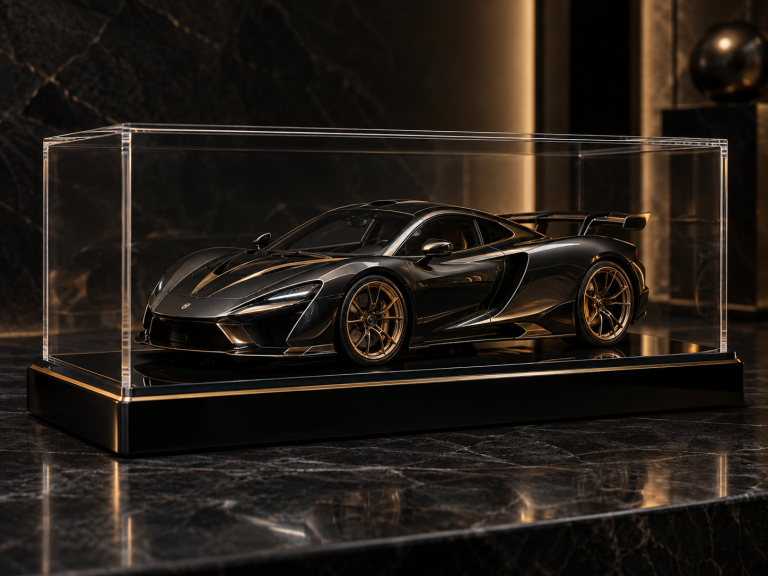
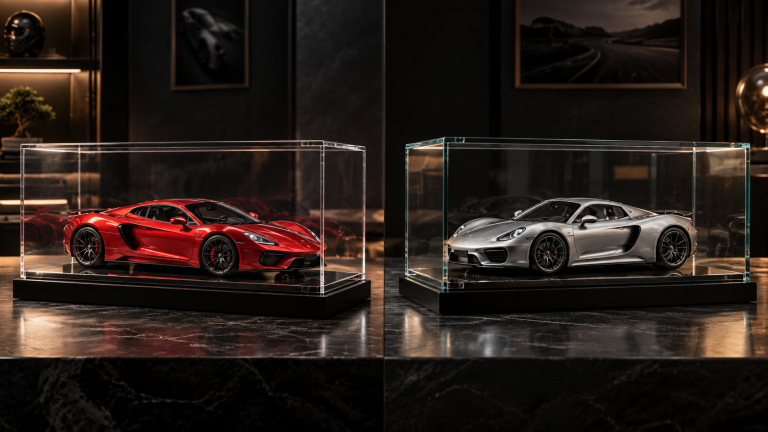
Single-car acrylic cases suit important individual models, while wider shelving or multi-car solutions make more sense when the collection grows. Either way, keeping the dimensions consistent can make a mixed collection feel much more organised.
How to measure your 1:18 model correctly
Use a ruler or tape measure and record three dimensions:
- Length: furthest point at the front to furthest point at the rear.
- Width: the widest point, which may be the mirrors, tyres or rear wing rather than the body itself.
- Height: from the surface beneath the tyres to the highest fixed part.
If the model sits on a manufacturer plinth, measure the plinth as well if you plan to display the car without removing it.
For enclosed cases, compare your measurements with the internal dimensions. External measurements include the thickness of the acrylic and base and therefore do not tell you how much usable space the model actually has.
Frequently asked questions
How many inches long is a 1:18 model car?
Most standard passenger cars at 1:18 scale are approximately 9–12 inches long, although compact vehicles may be shorter and larger vehicles can exceed that range.
Is 1:18 considered a large model car scale?
Yes. Among commonly collected diecast scales such as 1:64, 1:43, 1:24 and 1:18, 1:18 is the largest and usually requires the most dedicated display space.
Will every 1:18 car fit the same display case?
No. The real vehicles have different dimensions, so their scaled models do too. A case that comfortably fits a compact sports car may not suit a long saloon, pickup or wide racing model.
What internal case size should I look for?
Measure your model first. Many typical 1:18 passenger cars can be accommodated by cases around 30–32 cm long internally, but this should be treated as a starting point rather than a guarantee.
Should I include the mirrors when measuring?
Yes. Measure the widest fixed point of the model, which is often the mirrors, tyres or aerodynamic bodywork.
Give a 1:18 model enough room to look like a display piece
A 1:18 model is large enough to become a genuine feature rather than simply another object on a shelf. For most passenger cars, expect something in the region of 23–30 cm long, but always remember that the scale describes the ratio — not one universal finished size.
Measure the exact model, allow some breathing room and choose a display around the car rather than relying only on the 1:18 label. Doing that gives the model more visual impact and makes it far easier to plan a collection as it grows.
Explore our Model Car Display Cases, browse 1:18 Model Car Display Cases, or read our Complete Guide to Model Car Display Cases for more display-planning advice.